Have you ever wondered about the invisible threads that connect us across time? We often talk about "generations" – our grandparents' generation, our own, or the one coming after us. But if you've ever paused to consider it, the question of "how long does a generation last" isn't as simple as it seems. It's a fascinating puzzle that blends personal lineage with broader societal shifts, influencing everything from family dynamics to cultural trends and even economic policies.
At its core, a generation is a collective of people born at roughly the same time, sharing common experiences that shape their worldview. While most people instinctively agree this span falls somewhere between 20 and 35 years, the precise definition can vary significantly depending on whether you're looking at your family tree or analyzing societal trends. Understanding these nuances is key to appreciating the rich tapestry of human history and connection.
Unpacking the Different Dimensions of a Generation
The concept of a generation isn't a monolith; it shifts and changes based on the lens through which we view it. Primarily, we distinguish between family generations, rooted in direct lineage, and social generations, which bind together groups based on shared historical moments and cultural experiences.
Family Generations: The Threads of Kinship
When we speak of family generations, we're talking about the natural flow of descent – parents to children, and so on. This definition typically estimates a generation to be about 20 to 30 years long, reflecting the average time it takes for a new generation to be born and begin having children of their own. Genealogists, for instance, rely heavily on this definition as they trace ancestral lines, moving from one direct ancestor to the next.
However, modern life is making this definition a bit more fluid. With longer life expectancies and people choosing to have children later in life, the traditional 20-30 year span can sometimes feel stretched. It's a dynamic measure that mirrors the biological and life stage realities of a family.
Social Generations: Shared Lives, Shared Worlds
Sociologists, on the other hand, define social generations as groups of individuals who are born and live roughly at the same time, often experiencing similar formative events during their youth and young adulthood. This perspective usually pegs a generation at a shorter span, typically 15 to 20 years. This timeframe reflects the average period for a cohort to be born, grow up, and start to influence the world as adults, which is where the common idea of a 20-year generation length often originates. In fact, some researchers even propose a generation could be as brief as 15 years. The mainstream adoption of classifying people into distinct social generations largely took hold in the late 1900s. To truly grasp these different frameworks and their implications, you might want to delve deeper into What defines a generation in more detail.
The Evolving Landscape of Generational Length
The understanding of how long a generation lasts hasn't been static throughout history. Even ancient texts reflect an awareness of generational spans, albeit without explicit numerical definitions. For instance, biblical scholars often estimate a generation to be around 30 years, aligning with the average human lifespan approximately 2,000 years ago. This historical context shows that the idea of generational length has always been tied to the prevailing conditions of an era.
Interestingly, scientific research provides even more granular insights, suggesting that male generations tend to be about a third longer than female generations, with female generations being longer by roughly half that amount. These biological differences, combined with societal factors, contribute to the complexity of a seemingly simple question. If you're curious about how these definitions and lengths have shifted through the ages, it’s worth taking the time to Understand generational length evolution.
What Shapes a Generation?
The length and character of a generation aren't arbitrary. A multitude of factors contribute to their timelines and the defining traits they develop. Major historical events, technological breakthroughs, economic conditions, and even shifts in social values all play a crucial role. For example, a war or a major economic depression can profoundly impact a cohort, leaving an indelible mark on their collective psyche and experiences, effectively setting them apart from those who came before or after.
Even demographic trends, such as birth rates and life expectancy, subtly influence how we perceive and categorize these groups. The introduction of widespread digital technology, for instance, created a stark dividing line for younger generations, shaping their development in ways that previous generations could never have imagined. Understanding these intricate forces is vital to appreciating why generational boundaries exist and how they are drawn. To get a more in-depth look at these drivers, consider exploring Factors Influencing Generational Timelines.
Spotlight on Modern Generations: Our Shared Human Story
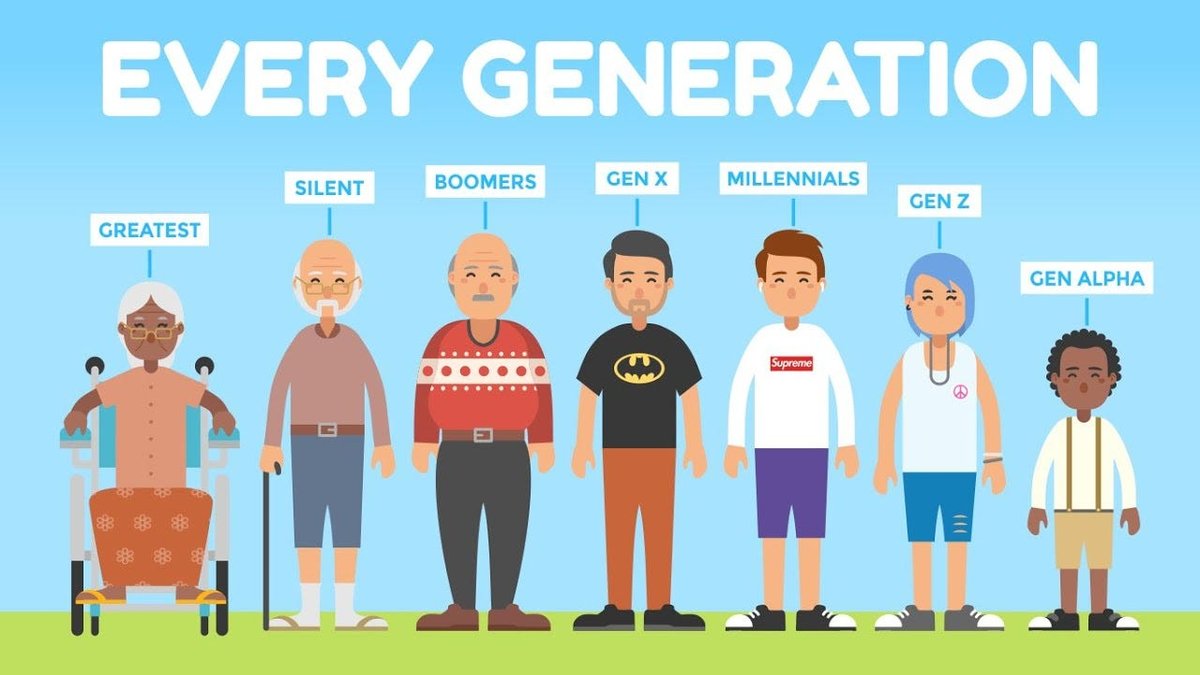
Over the past century, most experts agree we've witnessed the emergence of six distinct social generations, each with its unique moniker, birth years, and defining characteristics. These labels help us categorize shared experiences and understand the different worldviews that coexist within society today.
Here's a look at the major cohorts that have shaped, and continue to shape, our world:
- The Greatest Generation (GI Generation): Born roughly in 1924 or earlier, this cohort was coined by Tom Brokaw in 1998. They are defined by their formative experiences during the Great Depression and their heroism in World War II.
- The Silent Generation: Spanning births from approximately 1924-1945 (or 1925-1942, about 17 years), this term was coined by Time Magazine in 1951. They are often characterized by conformity and hard work, having come of age during a period of war and McCarthyism.
- Baby Boomers: Born between 1946 and 1964 (18 years), this generation's name originates from the post-World War II surge in birth rates. Identified by the U.S. Census Bureau, they often represent a generation of unprecedented economic growth and social change.
- Generation Jones (Boomers II): A distinct sub-group within Baby Boomers, typically born between 1955 and 1965. They are often associated with the rise of mass consumerism and a sense of unfulfilled expectations compared to their older Boomer counterparts.
- Generation X (Baby Busters, Lost Generation): This group, born from 1965 to 1980 (15 years), was famously coined by Douglas Coupland in 1991. They are often seen as independent, resourceful, and somewhat cynical, bridging the gap between analog and digital worlds.
- Generation Y/Millennials (Echo Boomers): Comprising those born between 1981 and 1996, Millennials are known for experiencing the turning of the millennium during their youth. They are often characterized by their digital fluency, optimism, and value for community.
- Generation Z (iGeneration): Born from 1997 to the present, Generation Z is the first generation to grow up entirely in a world saturated with digital technology and the internet. They are often described as highly diverse, pragmatic, and globally aware.
Understanding these specific cohorts and their defining periods allows us to appreciate the distinct perspectives each brings to the table. For a deeper dive into these influential groups and their exact birth ranges, you'll want to Explore major generations.
Uncovering Your Own Ancestral Journey and Generational Insights
Beyond academic definitions, the concept of a generation becomes deeply personal when we look at our own family history. Understanding the length of generations can be incredibly helpful for tracing your lineage and connecting with your ancestors. Thankfully, a wealth of resources exists to help you piece together your family's story across the generations.
Tools for Tracing Your Family's Footprints
To truly Explore generational span data within your own family and community, a combination of modern and historical records proves invaluable:
- DNA Testing: Provides a scientific glimpse into your personal history, helping identify ancestral origins, ethnic groups, and even potential family health patterns.
- Old Newspapers: A treasure trove of local stories, marriage announcements, obituaries, and community news that can offer rich, contextual details about your ancestors' lives in the 19th and 20th centuries.
- U.S. Census Records: Digitized records up to 1950 are an excellent starting point, detailing where individuals lived, who they lived with, and basic demographic information.
- Military Records: These documents can reveal where and when a soldier served, their unit, and any honors or decorations received, painting a picture of their wartime experiences.
- Birth Certificates: Essential for confirming exact birth dates and parental information, often correcting inaccuracies found in later records.
- Marriage Records: Official certificates and local newspaper accounts can provide crucial details about the bride, groom, their parents, and sometimes even offer photographs or charming contextual stories.
- Death Certificates: Confirming the date and cause of death, these are often complemented by detailed obituaries in newspapers that describe the individual's life, accomplishments, and the family they left behind.
By meticulously combining official vital statistics with the anecdotal richness found in old newspapers and other historical documents, you can form a remarkably complete picture of your ancestors and the generational landscape they inhabited.
Ultimately, the question of "how long does a generation last" invites us into a deeper understanding of ourselves, our families, and the wider human experience. It's a dynamic concept, continually redefined by biology, history, and innovation, reminding us that we are all part of an ongoing, interconnected story. As new generations emerge, they will undoubtedly continue to shape and redefine what it means to belong to a distinct cohort, leaving their own unique mark on the timeline of humanity.